Module 1: Live Sound Reinforcement Fundamentals
- Overview
- Videos
- What Is Live Sound Reinforcement?
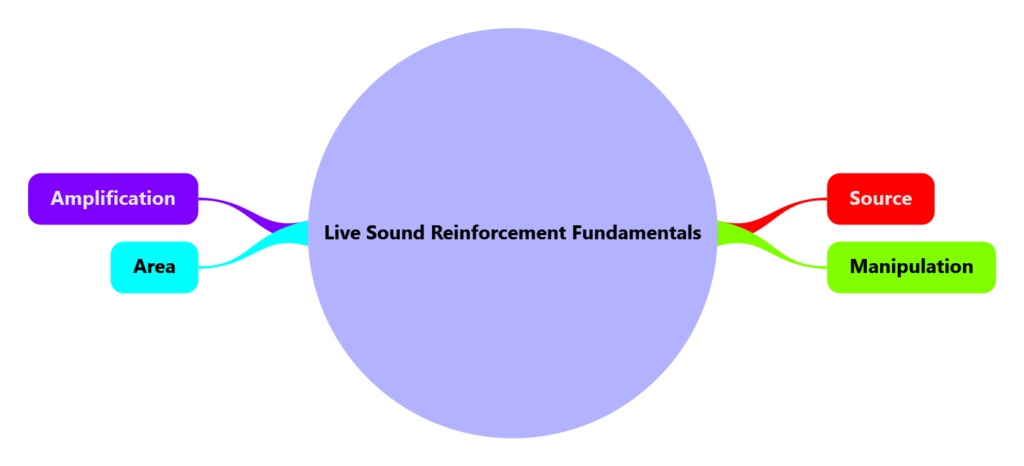
- Source
- Amplification
- Manipulation
- Area
- Readings
- Activities
Overview
In this module, you will be introduced to the fundamentals of live sound reinforcement and the role of a live sound engineer. We will explore how sound reinforcement allows sources such as vocals, instruments, and presenters to be heard clearly across different environments through the processes of amplification and manipulation.
A major focus of this module is understanding that live sound is not only about equipment, but also about working with the physics of sound. You will explore how room acoustics, reflections, reverberation, and absorption influence the way engineers approach mixing in different spaces.
By the end of this module, you should have a foundational understanding of what live sound reinforcement is, how sound reinforcement systems function, and how engineers adapt their approach based on the environment in which they are working.
Live Sound Engineer
In this video, veteran live sound engineer Ken “Pooch” Van Druten discusses what it takes to succeed as a live sound engineer at the highest levels of the industry. Throughout his career, Pooch has worked with major artists including Linkin Park, Justin Bieber, Iron Maiden, and many others.
He explains that live sound engineering is about much more than simply operating equipment. Success in the field requires strong technical knowledge, problem-solving skills, and the ability to communicate and work effectively with artists, crew members, and production teams.
During the interview, Pooch references a variety of professional live sound equipment and workflows. Don’t worry if you don’t understand every piece of gear or every technical term being discussed.
Instead, use this video as an opportunity to observe what a professional live sound engineer’s world looks like and to begin developing an understanding of the people, technology, and environments that make live events possible.
Ken “Pooch” Van Druten – Live Sound Engineering Interview
Monitor Engineer
Large concert productions often have a dedicated monitor engineer whose primary responsibility is mixing the stage monitors or, more commonly, the in ear monitor (IEM) mixes for the performers. Unlike the front of house engineer, who mixes for the audience, the monitor engineer mixes exclusively for what the artists hear while performing on stage.
Each performer typically receives a customized monitor mix tailored to their preferences. These mixes often include the same level of care and detail as the front of house mix, using EQ, compression, reverb, delays, and other processing to help performers hear themselves and the rest of the band clearly and comfortably.
The video below follows a monitor engineer for Beyoncé, providing a behind the scenes look at the role, workflow, and responsibilities involved in creating professional in ear monitor mixes for a world class touring production.
Daniel Gonzales – Monitor Engineering Interview
Broadcast Engineer
Many concerts and live events are also live streamed or broadcast to audiences watching from home. In these productions, a dedicated broadcast engineer creates a separate mix specifically for television, computers, tablets, and smartphones.
Unlike the front of house engineer, who mixes for the audience in the venue, the broadcast engineer mixes for the audience at home, ensuring the performance sounds clear, balanced, and engaging.
The video below provides a behind the scenes look at broadcast audio engineering for an MLB game.
MLB Broadcast Mix – Behind the Scenes
What Is Live Sound Reinforcement?
Most people have a general idea of what live sound reinforcement means. If you’ve ever attended a concert, festival, conference, or live event, you’ve already experienced it in action. But what exactly is sound reinforcement, and why is it necessary?
According to Teddy Boyce, author of Live Sound Reinforcement, sound reinforcement is:
“The process of manipulating and amplifying sound for the purpose of allowing a small source to be heard and understood over an area that the source, by itself, would be incapable of covering adequately.”
There is quite a bit to unpack in this definition, but let’s deconstruct some of the words used in the definition above; source, manipulating, amplifying, and area.
Source
All live sound reinforcement begins with a source. The source is the starting point of signal flow and serves as the foundation for everything else in the audio chain, a topic we will explore in much greater detail later in the course.
A source is anything that produces sound: a vocalist, guitarist, drummer, bassist, keyboard player, or presenter. Each source produces sound at different volume levels and with different tonal characteristics. For example, a drummer is typically much louder than a vocalist, while an electric guitar amplifier may be louder than the vocals depending on the performance environment.
Because every source is unique, each requires different microphone choices and microphone placement techniques. The microphone used for a vocalist is often very different from the one used on a guitar cabinet or a kick drum. Likewise, where the microphone is positioned can have a significant impact on the captured sound.

Finally, the amount of amplification required will vary from source to source. A vocalist often requires more reinforcement through the sound system because the human voice alone may not be loud enough to fill a venue. Drums, on the other hand, can produce a considerable amount of acoustic volume on their own and may require less amplification, particularly in smaller venues.
This brings us to the next stage of the signal chain: amplification.
Amplification
Whenever you’re working in a venue with an audience, whether it’s a small coffee shop, lecture hall, theater, or large festival, there is a good chance you’ll need to amplify the sound so that everyone in attendance can hear the source clearly. This is the role of sound reinforcement.
Amplification is more than simply “turning up the volume,” although increasing volume is certainly part of the process.
Most sound sources in live audio begin with a microphone. The source itself, a vocalist, guitar amplifier, drum, or presenter, creates vibrations in the air. The microphone’s job is to convert those acoustic vibrations into an electrical signal that can be processed by the sound system.

The primary function of a microphone is therefore to translate sound energy into electrical energy.
However, the electrical signal generated by a microphone is extremely weak and cannot be used directly by most audio equipment. This weak signal is known as mic level.
The first stage of amplification occurs at the microphone preamplifier, or preamp. The preamp takes the weak mic-level signal and increases it to a much stronger line-level signal. Once the signal reaches line level, it becomes suitable for processing and manipulation using tools such as equalizers (EQs), compressors, gates, and effects processors.
Converting mic level to line level is the first major stage of amplification in a live sound system.
From there, the signal is routed through the mixing console where the engineer can adjust its level using channel faders and determine how much of that signal is sent to the loudspeakers.
Before the signal reaches the speakers, however, one final stage of amplification is required: the power amplifier.
Why do we need a power amplifier?
Loudspeakers require a significant amount of electrical power to physically move their drivers (or speaker cones) back and forth. It is this movement of air that creates the sound waves we hear. A line-level signal does not contain enough power to move a loudspeaker effectively.
The power amplifier takes the line-level signal and increases it to speaker level, providing enough electrical energy to drive the loudspeaker and reproduce sound for the audience.
In summary, live sound reinforcement typically involves three primary signal levels:
Mic Level → the weak electrical signal produced by a microphone
Line Level → the stronger signal used by audio equipment for processing and routing
Speaker Level → the high-power signal required to drive loudspeakers
The diagram below illustrates these stages of amplification within a typical live sound system.

Manipulation
In live sound, manipulation refers to the process of shaping and balancing audio sources so they work together as a cohesive mix. Simply making a source louder is not enough. The goal is to ensure that every important element can be heard clearly and that the entire performance sounds musical and balanced.
This process is known as mixing.

A common approach in live sound is to begin with the rhythm section, followed by instruments, then vocals. Since the audience typically wants to hear and understand the vocalist above everything else, the engineer may spend more time setting an appropriate vocal level and ensuring there is vocal clarity coming through the loudspeakers.
Beyond balancing levels, the engineer must also ensure that instruments are not competing for the same sonic space. If multiple sources occupy similar frequency ranges, they can mask one another and reduce clarity in the mix.
This is where an equalizer (EQ) becomes an essential tool. EQ allows engineers to shape the frequency content of individual sources so that each instrument has its own place within the mix.
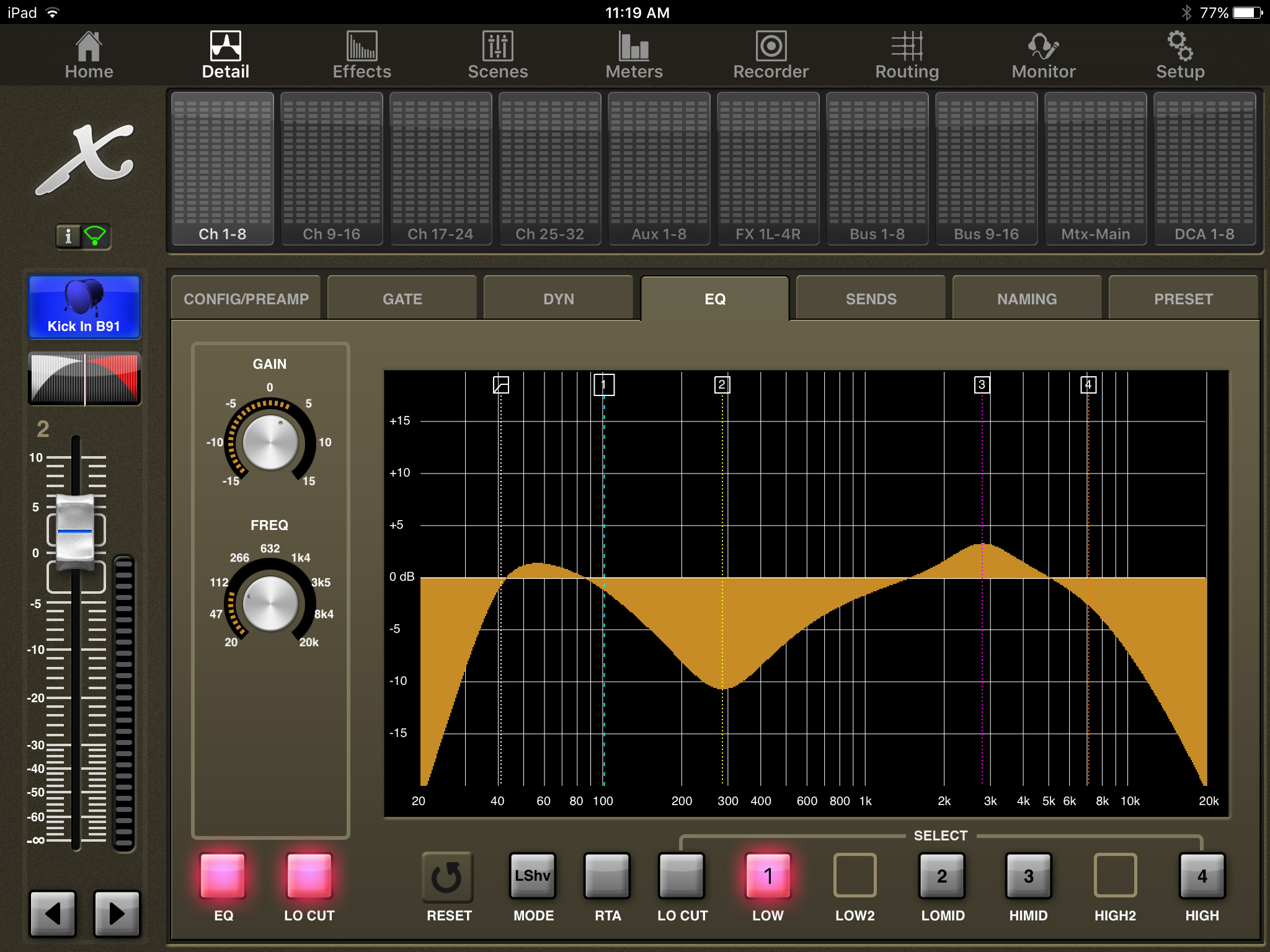
Additional processing tools are commonly used as well:
Compressors help control dynamic range, making sources such as vocals sound more consistent and controlled.
Gates can reduce unwanted bleed or background noise by attenuating signals when they fall below a certain threshold.
Reverb and other time-based effects can add depth, ambience, and a sense of space to the mix.
Ultimately, there is no single “correct” mix. The decisions a live sound engineer makes depend heavily on the venue, the performers, the audience, and the acoustics of the space itself.
This brings us to one of the most important concepts in live sound reinforcement: the physics of sound and how sound behaves within a room.
Area
When I began my journey in live sound, one of the first things I noticed was that the way I used EQ, reverb, and delay changed depending on the environment I was mixing in. This is because live sound engineers don’t simply mix to the equipment—they mix to the room.
Early in my career, a mentor told me:
“You can’t fight physics.”
Over the years, I’ve found that statement to be absolutely true. You can’t fight the acoustics of a space; you can only learn to work with them.
Every venue sounds different because of its size, shape, construction materials, and the objects within it. A small church will sound very different from a theater, and both will sound dramatically different from an outdoor festival or stadium. As a result, the way you use your audio tools changes depending on the space you’re mixing in.
Much of this comes down to two important acoustic concepts: reverberation and absorption.
Reverberation
As you may already know, reverberation is the result of sound reflections within a space. Some rooms are naturally more reverberant than others because of their size, shape, and surfaces.
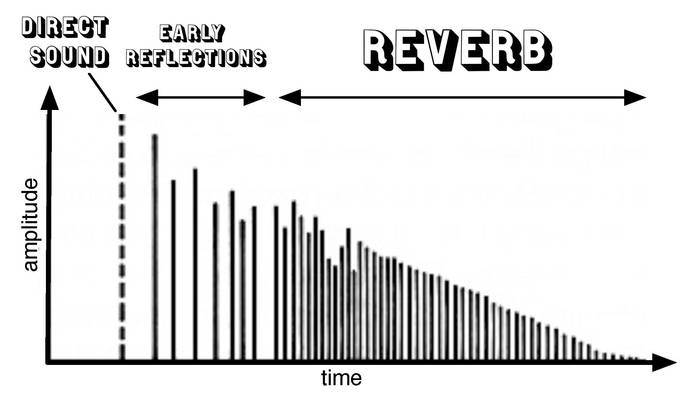
When an audience member listens to a loudspeaker, they are actually hearing several acoustic events occurring almost simultaneously:
Direct Sound
Direct sound is the sound traveling directly from the loudspeaker to the listener without reflecting off any surfaces. This arrives first, has the highest intensity, and provides the greatest clarity and intelligibility.
Early Reflections
This is the reflections arriving shortly after the direct sound, typically within approximately the first 50-80 milliseconds. These reflections can enhance a sense of space but can also reduce clarity if they become too prominent.
Reverberation
This is the collection of reflections arriving after the early reflections, often beginning around 80-100 milliseconds after the direct sound. This contributes to the perceived ambience and reverberation of a room.
As a front-of-house engineer, you probably won’t spend much time adjusting early reflection parameters on a reverb unit during a live show. More often than not, you’ll choose a reverb that complements the room and the music and make minor adjustments as needed.
However, understanding how loudspeakers interact with a space allows you to work with the acoustics rather than against them.
This understanding is equally important when creating mixes for livestreams and broadcasts. The audience at home doesn’t experience the acoustics of the venue in the same way the in-person audience does, so engineers often need to recreate some of that sense of space artificially to make the mix feel natural and immersive.
Absorption
Just as important as reflection is absorption.
Sound energy is absorbed by both objects and air as it travels through a space.
Different materials absorb sound differently. Thin commercial carpet absorbs sound differently than grass, and both absorb frequencies differently across the spectrum. This is where we encounter the concept of absorption coefficients, which describe how much sound energy a material absorbs at a particular frequency.
For example, grass generally absorbs more mid and high frequencies than thin commercial carpeting. As a result, the EQ decisions you make for an outdoor festival may differ significantly from those you make in a carpeted conference room or theater.
People are also highly effective sound absorbers.

During soundcheck, venues are often empty, meaning there are fewer absorbing surfaces and more opportunities for sound to reflect throughout the room. Once the audience arrives, however, hundreds or even thousands of bodies begin absorbing sound energy—particularly in the mid and high frequencies.
This means the mix you created during soundcheck may not be the mix that works once the show begins.
Experienced live sound engineers continuously adjust EQ, dynamics, and overall tonal balance throughout a performance to compensate for these changes and maintain the sound the artist and audience expect to hear.
At the end of the day, it is called live sound reinforcement for a reason. We are reinforcing the sound produced by the source so that it can be heard clearly throughout the venue. The audience ultimately hears a combination of the direct sound from the loudspeakers along with the reflections created by the size, shape, and acoustic characteristics of the room.
This is why developing a conceptual understanding of sound is so important for live sound engineers. The way we use our audio tools, and the decisions we make while mixing, will change depending on the environment we are working in. A technique that works perfectly in a small theater may not work in a church, arena, or outdoor festival.
Great live sound engineers do more than operate equipment; they understand the acoustics of the space and adapt their approach to work with the environment rather than against it.
Readings
Reflection
Reflections are a way of noting comments, questions, or concerns you have about this module. Please do not review the learning material. We all viewed and read the same material. Instead, offer us your personal thoughts, insights, confusions, and questions. Feel free to go beyond the learning material and find connections with your personal experiences. Please include one or two questions at the end of your document.
You can make your reflections as long as you want, but it should be a minimum of 150 words. You can also write your reflection on any word program, however it must be submitted as a PDF or as a text entry on Canvas. You can use the link below to submit your reflection.